
 Collect Video Testimonials That Build Trust
OpenAI CEO Sam Altman says AI companies should strengthen safety practices during model development, support independent oversight, and avoid allowing competitive pressure to push capabilities ahead of safeguards.
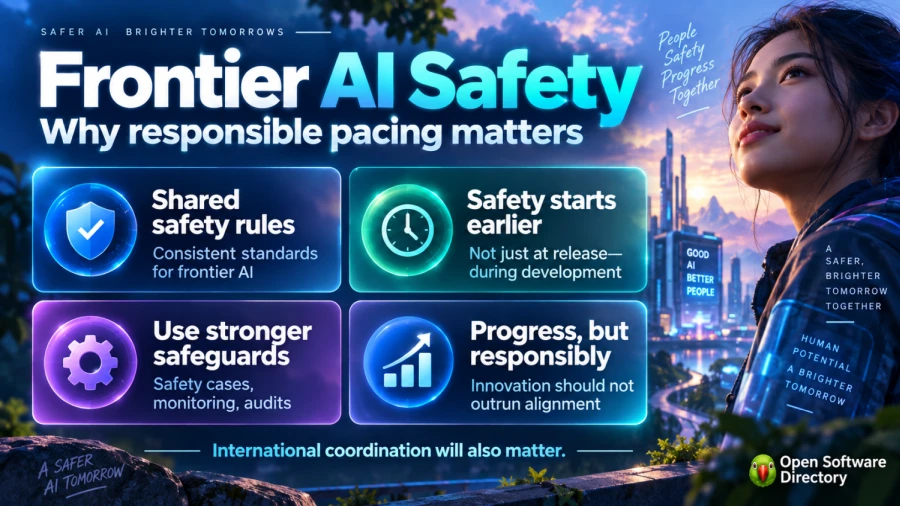
OpenAI CEO Sam Altman has called for stronger and more consistent safety standards across companies developing frontier artificial intelligence, arguing that safety should become an integral part of the development process rather than something considered mainly before a model is released.
In a recent post, Altman said the world deserves confidence that American companies building increasingly capable AI systems will act responsibly as the pace of technological progress accelerates. He said every frontier AI laboratory has a responsibility to demonstrate that commitment.
Altman welcomed the idea of a federal framework establishing consistent safety requirements for frontier AI. However, he argued that companies do not need to wait for legislation or an antitrust exemption before beginning to cooperate on stronger safety practices.
He also pointed to independent auditing as one possible way of creating greater confidence around frontier AI development.
AI Safety Is Moving Earlier in Development
AI companies have previously created frameworks such as Responsible Scaling Policies and preparedness systems to evaluate risks associated with increasingly capable models.
According to Altman, many of those approaches were designed primarily around completed models and decisions about deployment. The next phase of AI safety will increasingly need to address what happens while advanced systems are still being developed.
Altman said OpenAI now formulates explicit safety cases before certain frontier reinforcement learning runs that are expected to significantly increase model capabilities.
This changes the timing of safety evaluation. Instead of asking only whether a completed model is safe enough to deploy, developers may also need to determine whether sufficient safeguards are in place before undertaking training that could substantially increase capabilities.
Shared Standards Across Frontier AI Labs
Altman said OpenAI hopes other AI companies will learn from its approaches while developing and proposing their own safety methods.
He highlighted areas including misalignment, monitoring and safety where shared industry standards could improve outcomes.
Common standards could also make it easier for governments, researchers and independent organizations to evaluate whether frontier AI companies are applying appropriate safeguards as their systems become more powerful.
Independent auditing could eventually become an important part of that process, providing external verification rather than relying entirely on assessments conducted by AI developers themselves.
Pacing Does Not Mean Stopping AI Progress
Altman also addressed the idea of slowing the pace of AI development for safety reasons.
He emphasized that “pacing” does not mean stopping progress. AI development has advanced rapidly and is expected to continue doing so.
However, safety cases, monitoring systems and other safeguards require time and resources. Implementing them can therefore make development slower than it otherwise might be.
Altman argued that this additional cost is worthwhile if it prevents AI capabilities from advancing faster than the industry’s ability to align and monitor increasingly powerful systems.
The principle is particularly important as competition between leading AI companies intensifies.
Competitive pressure, Altman argued, should not become a justification for taking unnecessary risks or allowing capabilities to move significantly ahead of the safeguards designed to control them.
International Coordination Will Matter
While individual companies can introduce stronger safety practices voluntarily, international coordination presents a larger challenge.
AI development is increasingly connected to economic competitiveness, national security and technological leadership. Establishing consistent expectations across countries will therefore require cooperation between governments as well as technology companies.
Altman said this is one area where government involvement will be particularly important.
For now, however, his message to frontier AI developers is that they should begin implementing the safeguards that are already within their control rather than waiting for governments to establish every rule.
The debate around frontier AI safety is therefore shifting from a question of whether models are safe enough to release to a broader question: Are developers prepared to safely take the next major step in AI capability?
As frontier systems become increasingly powerful, safety cases, monitoring, independent evaluation and shared standards may become as important to AI development as improvements in model performance themselves.
Progress can continue, but capabilities should not outrun alignment, monitoring and safety.
Venkat
 Reach Software Buyers in Relevant Categories